
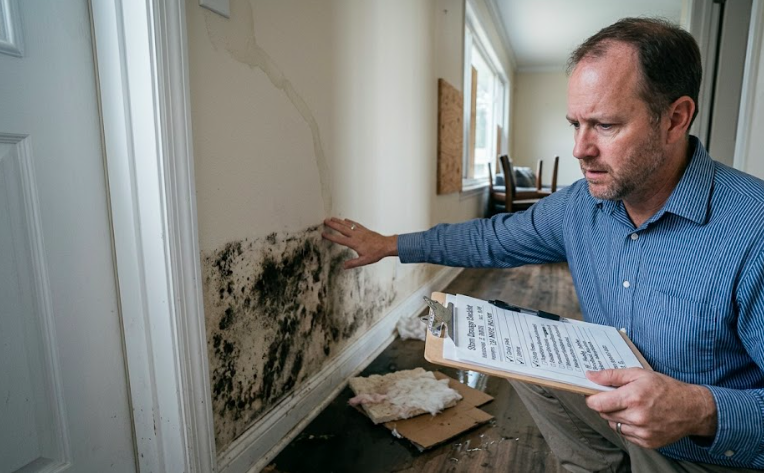
Mold is one of the most disputed line items in Texas homeowners insurance claims. The short answer: sometimes but only under very specific conditions tied to what caused the mold in the first place. If your home has experienced water damage and you’re now seeing mold growth, understanding your policy before you file a claim could save you thousands of dollars and weeks of headache.
This guide breaks down exactly when Texas homeowners insurance covers mold remediation, when it doesn’t, and what your options are when your insurer says no.
How Texas Homeowners Insurance Policies Treat Mold
Most Texas homeowners carry what the Texas Department of Insurance (TDI) classifies as an HO-A policy the state’s standard residential property form. Under TDI’s mandatory endorsement (Commissioner’s Order No. 01-1105), mold is explicitly excluded from HO-A coverage unless it results from a sudden and accidental water loss that is itself covered under the policy.
In plain terms: the mold doesn’t matter. The water source does.
There is also the HO-B policy a broader, all-perils form available primarily for newer homes. HO-B policies more commonly include some mold coverage and may offer optional mold endorsements at higher coverage tiers. However, HO-B eligibility is generally restricted to homes built within the past 30 years and may not be available through all carriers in every Texas county.
When Homeowners Insurance Will Likely Cover Mold
Texas insurers under both TDI-promulgated forms and approved ISO forms will typically pay for mold remediation when mold grows as a direct result of a covered, sudden, and accidental water loss event. Common examples include:
Burst or broken pipes – If a pipe ruptures suddenly and the resulting water intrusion leads to mold within a reasonable timeframe (typically 14–30 days), the mold remediation may be included as part of the covered water damage claim.
Appliance failures – A water heater that bursts, a washing machine hose that blows, or a dishwasher supply line that fails unexpectedly can all trigger covered water losses. If mold follows, it may fall under the same claim.
Storm-related roof damage – If a covered windstorm or hail event damages your roof and allows water to enter your home, any resulting mold is generally treated as part of the storm damage claim — provided repairs were initiated promptly.
Hidden or concealed leaks – Under TDI’s endorsement language, “sudden and accidental” can include physical damage that is hidden or concealed and not apparent to the homeowner. If a slow leak inside a wall was not visible or detectable, some carriers will treat it as covered.
Key requirement: Insurers are increasingly requiring documented proof that water mitigation was performed promptly. Delaying cleanup after water damage is one of the most common reasons mold claims are denied even when the underlying water event was covered.
When Homeowners Insurance Will NOT Cover Mold
The more common outcome particularly in humid South Texas markets is a mold claim denial. Coverage is typically excluded in the following scenarios:
Gradual leaks and long-term seepage – HO-A policies do not cover damage from continuous or repeated water leakage. If mold grew over weeks or months from a slow drip under a sink, behind a toilet, or along a foundation wall, expect a denial.
Flooding – Standard homeowners policies exclude flood-related losses across the board. Mold that develops after a flood event whether from heavy rain, storm surge, or rising water is not covered under your HO-A or HO-B. You would need a separate NFIP (National Flood Insurance Program) flood policy for this.
Poor maintenance – Insurers treat mold from inadequate ventilation, clogged gutters, neglected HVAC systems, or long-ignored roof damage as a maintenance failure. These claims are routinely denied.
HVAC condensation – Mold growth inside ductwork or air handler units caused by condensation buildup is almost universally excluded under the mechanical breakdown and maintenance exclusions.
Pre-existing mold – If an insurer’s adjuster determines mold was present before your coverage period, the claim will be denied entirely.
Coverage Caps: What Texas Policies Actually Pay
Even when mold coverage applies, payouts are limited. Most standard Texas homeowners policies impose a mold sub-limit a separate, lower cap that applies specifically to mold remediation costs regardless of your dwelling coverage amount.
Standard mold sub-limits in Texas policies commonly range from $5,000 to $10,000 per occurrence. Some carriers offer optional mold endorsements with higher limits $15,000, $25,000, or $50,000 for an additional annual premium that typically runs $200–$500 in moderate-risk regions and higher in South Texas coastal markets.
The problem: professional mold remediation in Texas costs $10–$25 per square foot, and a serious mold problem affecting multiple rooms, structural framing, or HVAC systems can easily reach $20,000–$40,000. A $5,000 sub-limit leaves most homeowners with significant out-of-pocket exposure.
How to Strengthen a Texas Mold Insurance Claim
If you believe your mold damage stems from a covered water event, these steps improve your chances of a successful claim:
- Document everything immediately – Photograph and video the water source, the water damage, and the visible mold before cleanup begins. Date-stamp all media.
- Begin water mitigation right away – Call a licensed water damage restoration company as soon as possible. Insurers increasingly require evidence of prompt mitigation before approving any mold-related payments.
- Report the loss within the required window – TDI-endorsed forms require loss reporting within 30 days of detection for hidden/concealed damage claims. Do not delay.
- Get a professional mold assessment – A licensed Texas mold assessor (licensed under TDLR, Chapter 1958 Occupations Code) can document the mold’s origin, extent, and likely cause. This professional report is critical for insurance documentation and is distinct from the company performing the remediation, which eliminates conflicts of interest.
- Review your policy’s mold sub-limit and endorsements – Pull your declarations page and look specifically for mold, fungi, or microbes coverage limits. If you have an older HO-A, you may have very limited or no mold coverage at all.
- Contact the Texas Department of Insurance (TDI) if your claim is disputed – TDI has consumer protection authority over insurers operating in Texas and can assist with claims disputes. Visit tdi.texas.gov for official guidance on Texas water damage and mold coverage.
What Happens When Insurance Denies the Claim
A mold claim denial or a payout that falls far short of actual remediation costs is common in Texas. When that happens, homeowners have several options:
Hire a public adjuster – A licensed public adjuster works for you, not the insurance company, and can re-document and re-present your claim with stronger evidence. They typically work on a percentage of the final settlement.
File a complaint with TDI – The Texas Department of Insurance accepts formal complaints against insurers for improper claim denials, unreasonable delays, or lowball settlements.
Consult a property insurance attorney – Texas has specific bad faith insurance laws that allow homeowners to pursue legal remedies when an insurer wrongfully denies or underpays a claim.
Pay out of pocket and move forward – In many cases, especially where mold originated from long-term maintenance issues, out-of-pocket remediation is the only path forward. Getting competitive quotes from licensed Texas mold remediators is essential.
One important note: Texas homeowners who file mold or water damage claims may encounter difficulty renewing coverage or obtaining new policies in the future, as claims are tracked in the national CLUE database. Weigh your deductible against the remediation cost before filing particularly for smaller mold problems.
South Texas Mold Risk Is Higher Than Most of the State
The Rio Grande Valley and surrounding counties sit in one of the most humid climatic zones in Texas. Summer humidity, frequent tropical weather systems, and the region’s aging housing stock combine to create elevated mold risk compared to drier parts of the state. Mold can begin colonizing a water-damaged surface within 24–48 hours under these conditions.
Homeowners in the McAllen, Brownsville, Laredo, and Corpus Christi metro areas should pay particular attention to their policy’s mold endorsement status and consider purchasing additional mold coverage if their current policy sub-limit is below $15,000.
Water Damage Restoration and Mold Remediation: Why Speed Is Everything
Whether or not your insurance covers mold removal, the outcome and your costs are directly tied to how quickly the underlying water damage is addressed. Mold that is caught within 24–48 hours of a water event can often be contained before it spreads to structural materials. Mold discovered weeks or months later is almost always a more extensive and expensive remediation job.
Professional water damage restoration includes extraction, drying, dehumidification, and moisture monitoring all of which directly determine whether mold takes hold. Insurers are now requiring documented moisture logs and drying reports as part of mold claim packages.
→ Learn more about our water damage restoration services
Frequently Asked Questions
Does Texas require homeowners insurance to cover mold?
No. Texas does not require insurers to cover mold under standard HO-A policies. Coverage is only available when mold results from a covered, sudden, and accidental water loss event and even then, it is often subject to sub-limits.
What is the mold coverage limit on a typical Texas homeowners policy?
Most standard Texas homeowners policies cap mold coverage between $5,000 and $10,000 per occurrence. Optional endorsements can raise that limit to $15,000, $25,000, or higher for an additional premium.
Does flood insurance cover mold in Texas?
A standard homeowners policy excludes flood damage, including related mold. Separate NFIP flood insurance may cover mold remediation when the mold directly results from a covered flood loss but standard flood policies also have significant limitations on mold-related payouts.
How long does it take for mold to grow after water damage?
Under warm, humid conditions common across South Texas, mold can begin growing within 24–48 hours of water damage. This is why immediate water extraction and drying is critical both for mold prevention and for supporting a potential insurance claim.
Do I need a licensed mold remediator in Texas?
Yes. Under Texas Senate Bill 1255, effective September 1, 2025, workers involved in mold assessment or remediation must be licensed or registered under TDLR (Texas Department of Licensing and Regulation). Always verify that any mold contractor you hire holds a current Texas mold license.
External Resource
For official guidance on Texas mold licensing requirements and remediator verification, visit the Texas Department of Licensing and Regulation (TDLR): https://www.tdlr.texas.gov/mold/mold.htm
For official TDI guidance on water damage and mold insurance coverage in Texas, visit: https://www.tdi.texas.gov/tips/when-are-water-damage-and-mold-covered-by-insurance.html
Need Help After Water Damage in the McAllen Area?
If your home has suffered water damage and you’re concerned about mold, the most important step is fast, professional water mitigation regardless of what your insurance ultimately covers.
→ Visit our homepage to learn about our emergency water damage response, or explore our service areas to confirm coverage in your community.
Leave a Reply