
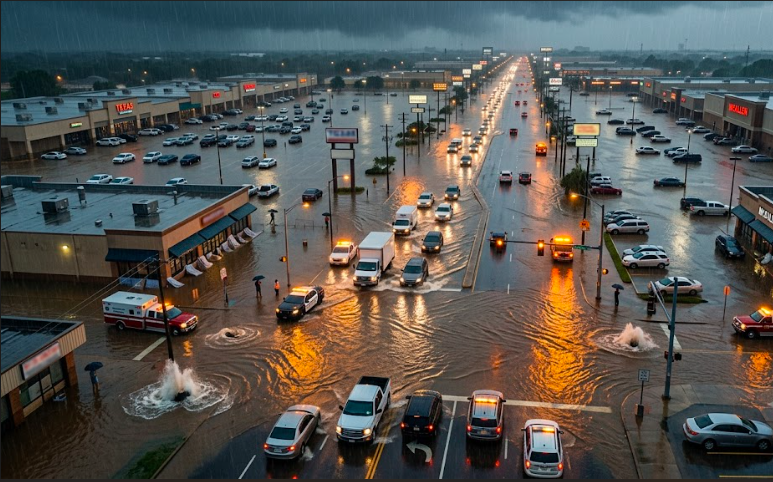
If you own, manage, or lease commercial space anywhere in the Rio Grande Valley, you already know how quickly a McAllen sky can change. One hour it’s a blazing 97°F with zero clouds; the next, you’re watching a wall of water pour off your roof while storm drains back up in the parking lot. And unlike many other Texas cities, McAllen’s near-perfectly flat geography gives that water nowhere to go fast except into your building.
This combination of intense, recurring rainfall and low-gradient terrain makes commercial water damage in McAllen one of the most consistent (and costly) threats that local business owners and property managers face year after year. Whether you operate a retail strip, a medical office, a warehouse, or a multi-tenant office park, understanding exactly why this happens and what you can do about it is essential to protecting your investment.
In this guide, we break down the science behind McAllen’s flooding vulnerability, the specific ways it damages commercial properties, and the steps you should take immediately if water has already entered your building.
Why McAllen Gets Hit So Hard by Rainfall
The Rio Grande Valley Climate
McAllen sits at an average elevation of just 107 feet above sea level and receives approximately 22–28 inches of rain annually but what makes those numbers dangerous is not the annual total. It’s how that rain falls: in short, violent bursts, often dumping 3–6 inches in a matter of hours during tropical storm events, summer convective storms, and Gulf moisture surges that roll up from the south.
According to the National Weather Service Brownsville/Rio Grande Valley office, the McAllen metro area regularly sees flash flood watches and warnings between May and October, with some years logging multiple major flood events. The Valley’s proximity to the Gulf of Mexico means moisture-laden air is almost always available to fuel convective storm systems.
| Key Climate Stats for McAllen, TX: • Average annual rainfall: 22–28 inches • Peak flood risk season: May–October • Typical storm dump: 3–6 inches in 2–4 hours • Hidalgo County: among the highest flash flood risk counties in Texas |
Tropical Systems and Moisture Surges
McAllen doesn’t need a direct hurricane landfall to flood. Even tropical storms or remnant low-pressure systems making landfall hundreds of miles away on the Texas or Mexican Gulf Coast routinely funnel enormous amounts of moisture directly into the Rio Grande Valley. Events like Tropical Storm Hanna (2020) and previous Gulf systems have deposited 8–12 inches of rain in McAllen over 24–48 hours well beyond what any municipal storm drainage system in the area can handle at design capacity.
The Flat Terrain Problem: Why Water Has Nowhere to Go
Elevation change drives water movement. In hilly or mountainous cities, rain quickly runs downslope into creeks, rivers, and drainage systems. McAllen doesn’t have that natural escape route. The city’s topography essentially a broad, flat alluvial plain associated with the ancient Rio Grande floodplain means stormwater moves laterally at very low velocity. Water spreads wide and shallow instead of rushing away.
How This Affects Commercial Districts
McAllen’s commercial corridors including areas along US-83, Nolana Avenue, 10th Street, McColl Road, Ware Road, and the rapidly developing northern corridors near Sharyland are built on nearly zero slope. When a 4-inch rain event strikes, the result is predictable:
- Parking lots turn into temporary retention ponds within minutes.
- Perimeter landscaping berms channel water toward building foundations instead of away.
- Overwhelmed storm drains back up, pushing water back to surface level.
- Low-lying loading dock areas, ground-level entrances, and below-grade utility rooms flood first.
- Water finds the path of least resistance often straight under your building’s exterior doors, through expansion joints, or into unsealed utility penetrations.
McAllen Commercial Zones Most Vulnerable to Flood Damage
| Commercial Area / Corridor | Primary Flood Risk Factor |
| US-83 Business District | High impervious surface area; older drainage infrastructure |
| Nolana Avenue Retail Strip | Low-grade parking lots, frequent drain blockage |
| North McAllen (McColl / Ware Rd) | Rapid development outpacing stormwater capacity |
| South McAllen Industrial Zone | Flat warehouse pads with minimal grade away from structures |
| Sharyland / Mission Border Area | Cross-boundary drainage coordination gaps |
| Edinburg / Pharr Business Parks | Canal proximity increases back-flooding risk |
How Water Actually Enters Commercial Buildings in McAllen
Understanding the entry points is critical for both prevention and damage assessment. In our years of responding to commercial water damage calls across McAllen and the Rio Grande Valley, we see the same failure points repeatedly:
1. Foundation Intrusion and Hydrostatic Pressure
When water saturates the soil around a commercial building for an extended period, hydrostatic pressure builds against foundation walls and slab edges. Concrete is porous at a microscopic level, and any existing cracks, cold joints, or gaps around utility conduits become pathways for water to seep inward. This is especially problematic in McAllen’s clay-heavy soil, which expands when wet and creates uneven lateral pressure against foundations.
2. Overwhelmed HVAC Drain Lines
McAllen commercial buildings run their air conditioning systems nearly year-round given the South Texas heat. HVAC condensate drain lines produce significant water volume on humid days, and when a storm event temporarily overwhelms building drainage capacity, condensate backup can flood ceiling plenums, utility closets, and even tenant spaces all while the storm itself is also stressing exterior drainage.
3. Roof Drains and Interior Downspouts
Flat and low-slope roofs are the standard on commercial buildings in McAllen retail centers, office parks, light industrial facilities. These roofs rely entirely on interior drains or perimeter scuppers to move water off the roof deck. During an intense rainfall event, drainage capacity is easily exceeded, and water ponds on the roof. Ponded water finds seams, aging membrane joints, penetrations around HVAC equipment curbs, and areas where the roof has deflected over time. When it finds a way in, it typically travels a significant horizontal distance through ceiling insulation before it becomes visible inside.
4. Doors, Loading Docks, and Threshold Failures
Commercial entry doors especially large sliding doors, roll-up dock doors, and storefront glass systems have limited water resistance when water is moving horizontally or when standing water exceeds door threshold height. A simple 2-inch water depth in a parking lot that sits tight against a building entrance is enough to flow under most commercial door sweeps. Loading dock areas are especially vulnerable because they are intentionally kept at a lower grade to facilitate truck access.
5. Window Failures and Curtain Wall Penetrations
Older commercial buildings along McAllen’s established corridors often have aging window glazing systems with deteriorated sealants. Driving rain pushed by storm winds especially from tropical systems can force water through sealant joints that appear intact under normal conditions but fail under sustained wind-driven pressure.
The True Cost of Commercial Water Damage in McAllen
Commercial water damage is rarely a simple cleanup job. The financial impact compounds rapidly once water penetrates a building:
| Damage Category | Typical Cost Impact |
| Emergency water extraction & drying | $3,000–$25,000+ depending on square footage |
| Ceiling tile and drywall replacement | $5,000–$40,000 for mid-size commercial space |
| Flooring replacement (carpet, LVP, concrete) | $8,000–$60,000+ |
| HVAC system remediation/replacement | $5,000–$30,000 |
| Mold remediation (post-water damage) | $3,000–$50,000+ if delayed |
| Business interruption losses | Variable – often exceeds structural repair costs |
| Content and inventory loss | Variable – significant for retail and medical |
The damage timeline matters enormously: IICRC standards classify water damage by time elapsed. Class 1–2 water damage responded to within 24–48 hours is manageable. Class 3 saturation that sits for 72+ hours begins to support mold colonization in McAllen’s high-humidity environment often within 48 hours in South Texas summer conditions and dramatically escalates remediation costs and complexity.
| Important: Texas Mold Law – In Texas, commercial property owners have a legal duty to maintain habitable, mold-free conditions under Texas Property Code. Failure to remediate water damage promptly can create liability exposure with tenants, employees, and customers in addition to building code violations. External Reference: Texas Department of Insurance Business Interruption Claims Guide (tdi.texas.gov) |
Flood-Proofing Commercial Buildings in McAllen: Practical Prevention Steps
While no commercial building in a flat, high-rainfall environment can be made completely flood-proof, the following measures substantially reduce risk and accelerate recovery when events do occur:
Conduct a Professional Water Damage Inspection Before Storm Season
Before May when McAllen’s storm season ramps up schedule a professional water damage inspection of your commercial property. A trained restoration professional will identify foundation vulnerabilities, compromised sealants, drain conditions, and roof membrane issues that standard property management checklists routinely miss.
Install and Maintain Commercial Backwater Valves
Floor drains, utility sink drains, and sanitary sewer connections in commercial buildings can reverse-flow during flood events when the municipal sewer system is overwhelmed. Backwater valves also called backflow preventers block this reversal. They are inexpensive relative to the damage they prevent and are especially important for McAllen buildings with below-grade utility rooms, restrooms, or mechanical spaces.
Regrade Parking Lots and Landscape Away from the Building
One of the highest-impact, most cost-effective flood mitigation steps for McAllen commercial properties is ensuring positive grade drainage away from the building perimeter. Even a 1–2% slope directed toward parking lot drains or vegetated swales rather than toward the building foundation dramatically reduces water intrusion pressure during a heavy rain event.
Seal Foundation Penetrations and Expansion Joints
Every penetration through a commercial foundation for electrical conduit, plumbing, data lines, gas lines is a potential water pathway. These penetrations should be inspected and sealed with hydraulic cement or appropriate commercial-grade polyurethane sealant annually. Expansion joints are particularly vulnerable and should be treated with an appropriate flexible sealant or waterstop membrane.
Elevate Critical Equipment and Inventory
In known flood-risk areas loading dock areas, mechanical rooms, storage areas at or near grade level elevating electrical panels, server equipment, critical inventory, and HVAC components even 12–18 inches above the floor can be the difference between a manageable event and a catastrophic loss.
Install a Commercial-Grade Sump System
For commercial buildings with below-grade utility spaces, sumps with battery-backup pumps provide an active defense against groundwater intrusion during extended saturation events. Our team offers emergency sump pump installation and repair in McAllen call us before storm season to assess your needs.
What to Do Immediately When Your McAllen Commercial Building Floods
Time is your most valuable resource after a commercial flood event. Here is the action sequence that minimizes damage and positions your insurance claim for the best possible outcome:
- Step 1: Prioritize Safety
Do not enter a flooded building until you have confirmed that electricity to affected areas is off. Never wade into standing water without confirming there is no live electrical exposure. If in doubt, wait for emergency services.
- Step 2: Call a 24/7 Emergency Restoration Team
Call FloodFix Solutions at (956) 474-9668 immediately. Our McAllen team is available 24 hours a day, 7 days a week, and we typically arrive within 30–60 minutes for commercial emergencies. Early extraction and drying is the single most effective way to reduce total damage and remediation costs.
- Step 3: Document Everything Before Cleanup Begins
Photograph and video all affected areas, equipment, inventory, and structural elements before any cleanup or water removal begins. This documentation is essential for insurance claims and should be as comprehensive as possible.
- Step 4: Notify Your Insurance Carrier
Report the loss to your commercial property insurer immediately. Most commercial property policies have prompt-reporting requirements, and delays can complicate or invalidate coverage. Our team works directly with all major insurance carriers and can assist with the claims documentation process.
- Step 5: Do Not Use Interior Fans or HVAC to ‘Dry’ the Space
A common and costly mistake. Running standard fans or your building’s HVAC system through a water-damaged space spreads moisture into unaffected wall cavities, ceiling plenums, and ductwork dramatically increasing the scope of remediation needed. Professional structural drying requires industrial-grade equipment with controlled airflow and dehumidification calibrated to conditions.
Conclusion: McAllen’s Geography Demands a Proactive Response
The combination of high-intensity rainfall, near-zero terrain slope, rapidly expanding impervious surfaces, and aging municipal storm infrastructure makes commercial water damage in McAllen not a matter of if but when. Property owners and managers who understand these dynamics, invest in preventive measures before storm season, and have a trusted restoration partner on speed dial will consistently outperform those who rely on luck.
FloodFix Solutions is McAllen’s locally owned, 24/7 commercial water damage response team. Our IICRC-certified technicians understand South Texas weather patterns, the specific construction vulnerabilities common to Rio Grande Valley commercial buildings, and the local insurance landscape. We respond within 30–60 minutes and work directly with your insurance carrier to streamline claims and documentation.
| Is Your Commercial Property at Risk? Don’t Wait for the Next Storm. Call FloodFix Solutions Available 24/7 for Commercial Emergencies in McAllen, TX (956) 474-9668 mcallentxwaterdamage.com | 1800 S Main St, McAllen, TX 78503 Serving McAllen · Mission · Edinburg · Pharr · Alton · Sharyland · Rio Grande Valley |
FAQs: Commercial Water Damage in McAllen, TX
Q: Does commercial property insurance in Texas cover flood damage from heavy rainfall?
A: Standard commercial property insurance policies typically cover sudden and accidental water damage from internal sources (burst pipes, roof leaks), but most exclude external flood damage from ground-level inundation. A separate commercial flood insurance policy available through FEMA’s National Flood Insurance Program (NFIP) or private surplus lines carriers is required for that coverage. Review your policy with your agent and verify your property’s FEMA flood zone designation before storm season.
Q: How long does commercial water damage restoration take in McAllen?
A: Timeline depends on the extent of saturation. Emergency water extraction is typically completed within the first 24 hours. Structural drying of walls, flooring, and ceiling assemblies typically requires 3–5 days with professional equipment. Reconstruction of damaged drywall, flooring, and finishes can add 1–4 weeks depending on scope. Mold remediation, if needed, adds additional time. Our team will give you a realistic, detailed scope of work and timeline after the initial assessment.
Q: Can my commercial tenants hold me liable for water damage in McAllen?
A: Texas commercial landlord-tenant law does create obligations for property owners to maintain habitable, safe conditions. Water intrusion that is not promptly and properly remediated particularly if it leads to mold growth can expose commercial landlords to breach of lease claims. Documenting prompt professional response and remediation is your best protection.
Q: What should I look for after a heavy rain event even if I don’t see obvious flooding?
A: Check ceiling tiles for water stains or sagging, inspect the area around all ground-level door thresholds, look for efflorescence (white mineral deposits) on masonry walls which indicates water intrusion, check HVAC drain pans for overflow, and inspect utility rooms for moisture. Many significant moisture intrusion events produce no immediately visible signs but lead to mold growth behind walls within 48–72 hours.
Leave a Reply